
Several stinging insects are common in the Black Hills. Homeowners often mix them up. Knowing which species you have helps you understand the danger and the best way to get rid of them.
You will most often see paper wasps, yellow jackets, bald-faced hornets, and mud daubers in and around Rapid City, SD.
This table helps you tell them apart:
| Type / Species | Size | Appearance | Nest Location | Threat Level |
|---|---|---|---|---|
| Paper wasp | About 0.75 to 1 inch | Slender body, narrow waist, brown with yellow markings | Under eaves, porch ceilings, railings, shed overhangs | Moderate; defensive if nest is disturbed |
| Yellow jacket | About 0.5 inch | Compact body, bright yellow and black, less hairy than bees | Underground burrows, wall voids, insulation voids, attics, soffits | High; highly defensive, stings repeatedly |
| Bald-faced hornet | About 0.5 to 0.75 inch | Black with white face and pale body markings | Large enclosed paper nest in trees, shrubs, building overhangs | High; aggressive nest defenders |
| Mud dauber | About 0.5 to 1 inch | Slender, dark or metallic, thread-waisted | Mud tubes on walls, garages, barns, sheltered structures | Low; generally non-aggressive |
Paper wasps often build under eaves and porch ceilings here in western South Dakota. Yellow jackets are usually the biggest problem. Their nests can be hidden in the ground or inside your walls, and their groups can get very big. Bald-faced hornets make large, ball-shaped paper nests that hang in trees or under building overhangs. Mud daubers are mostly alone and often do not need treatment. 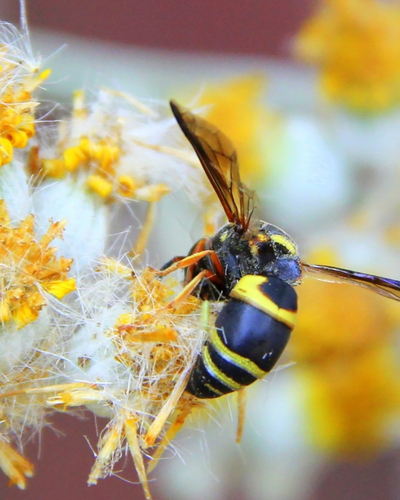
When most people say “hornets” in the U.S., they mean bald-faced hornets. True hornets are actually rare in South Dakota.
Some wasps are helpful because they eat other bugs. But if a nest is near people, pets, or places you use often, it usually needs to be taken care of. Treatment plans and risk change by species. Correct identification is always step one.
A nest is not always easy to see. Yellow jackets and nests inside walls are often hidden. Knowing the signs of activity helps you catch a problem early, before it gets worse.
Watch for insects flying to the same spot over and over, seeing nest material, or hearing loud buzzing in one area. These often mean an active nest is close.
Look for these signs around your home:
You often find hidden nests by watching the worker wasps. They will leave and come back to the same opening. If you see this focused traffic near a wall, do not seal that hole. Blocking it can push the insects deeper into your home or make them find a new way out inside.
Outdoor food and drinks also attract worker wasps. Sweet drinks, fruit, garbage, and pet food can draw yellow jackets to patios and decks. Keeping these things cleaned up and covered helps.
The main health worry with wasps and hornets is sting reactions, not sickness. But those reactions can be mild or very serious. Active nests near people should never be ignored.
Wasps and hornets cause painful stings, attacks with many stings, and severe allergic reactions. Anaphylaxis is a sudden, whole-body reaction that can be life-threatening.
Health risks include:
Yellow jackets and bald-faced hornets can sting many times very fast when they feel threatened. Unlike bees, they do not lose their stingers. One insect can sting over and over.
Property and safety risks include:
Trying to spray or knock down a nest without the right gear is very risky. The colony reacts fast and attacks in large numbers. If someone gets stung many times or shows signs of a bad reaction, call 911 right away.
Wasp and hornet problems are common in western South Dakota for a few reasons. Our warm season lets colonies grow a lot from spring through late summer. Dry, warm weather also means more contact between people and stinging insects outside.
By late summer, colonies are bigger and more defensive. This leads to more stings and nest activity around outdoor areas in Rapid City and across the Black Hills.
The Black Hills landscape has many sheltered nesting spots. Trees, cliffs, sheds, eaves, wall voids, and holes in the ground all give colonies a place to grow without being seen.
Wasp activity gets higher as the season goes on. Late summer and early fall are normally the most dangerous times. Colonies are at their biggest, food is more competitive, and the insects get more aggressive around outdoor eating areas, patios, and trash.
Businesses in Rapid City with outdoor seating see this clearly. Workers and customers can be targets for defensive yellow jackets or hornets when nests are nearby.
Timing is important for wasp control. Knowing when colonies grow and when they are busiest helps homeowners and businesses act at the right time.
Early spring is best for stopping nests before they start. Late summer and fall usually have the highest nest activity and sting risk in Rapid City.
Here is how the season normally works:
Queens come out from where they spent the winter and start building new nests. Nests are small now and easier to treat. Spring is the best time for prevention and early action.
Nests grow fast. Worker populations go up. Yellow jackets and paper wasps become easier to see around eaves, decks, and yards. This is the right time for inspections and treatment if you find nests.
This is the highest-risk time. Colonies are at their peak size. Workers are more defensive, especially around food. Yellow jacket activity around garbage and outdoor eating often spikes. Professional help is most needed during this time.
Most colonies die when it gets cold. Old nests might still be there, but they are empty. New queens survive the winter in sheltered spots and will start new colonies next spring. Wasps do not usually reuse old nests.
Ground nests can be hard to find. You often spot them by seeing steady insect traffic going in and out of a hole in the soil or mulch.
JanTech uses a step-by-step process to safely get rid of wasp and hornet nests. State-certified technicians handle each job with the right gear, knowledge, and targeted products.
We inspect, identify the species, treat the nest with protective equipment, and follow up to stop rebuilding.
Here is how our process works:
Most store-bought sprays do not reach far and are not made for hidden nests or large colonies. Spraying without the right gear can make the colony attack fast. Professional treatment is safer and more complete.
Contact JanTech Pest Control at 605-391-9998 for a free wasp and hornet inspection in Rapid City and the Black Hills area. We serve both homes and businesses.
Prevention works best in early spring before queens start new nests. A few steps taken at the right time can lower the chance of a nest forming on your property.
Seal entry points and check eaves, vents, and ground holes in early spring before queens start building.
Here are practical prevention steps:
Some tips work better for specific types:
Preventive treatments can be put down before nesting season starts. This is helpful for homes and businesses in the Black Hills that have had nest problems before. DIY prevention is good, but active nests with high risk should always be handled by a professional wasp removal service.
Some nests can be handled by a careful homeowner. Most cannot. Knowing when to call a pro is one of the most important things to understand about stinging insect control.
Call a professional for large, hidden, or high-risk nests. This is especially true for yellow jackets and hornets near people or buildings.
Call a wasp exterminator when:
DIY treatment is only sometimes okay for very small, easy-to-reach paper wasp nests in calm weather. Even then, it has risk.
Do not:
Professional wasp removal is important for homes, apartments, restaurants, office doors, and warehouses. Any place where people gather near an active nest is high-risk.
Some nests can be scheduled for routine removal. Others, like aggressive yellow jacket groups and large hornet nests, may need a fast response. If the nest is near a busy area in Rapid City, waiting usually makes it worse as the colony keeps growing.
Wasp nest removal cost is not the same for every job. JanTech prices jobs based on an inspection, not just the type of insect. This gives homeowners and businesses an accurate picture of what the job involves.
Cost depends on the species, nest size, location, how easy it is to reach, and how fast you need treatment.
The main factors that change the price:
Here are real examples of how location changes the job:
Rapid City properties with tall buildings, lots of trees, or ground nests have special access challenges. The Black Hills terrain adds to that. An inspection-based quote gives you the most accurate cost for your situation.
Start by figuring out the species and where the nest is. Small, low-risk paper wasp nests might be treated by a careful homeowner. But active yellow jacket or hornet nests are usually best for a professional. Safety depends on nest size, how hidden it is, and how defensive the colony is.
It can be risky, especially if the nest is large, hidden, or in the ground. Never seal a hole in a wall if wasps are using it. If you try a very small, low-risk nest, wear protective clothing and stop right away if the insects get aggressive. When in doubt, call a professional wasp removal service.
Prices change based on species, nest size, location, and how fast you need it. Hidden or hard-to-reach nests usually cost more because they take more time and need extra safety steps. The best way to get an accurate price is to schedule an inspection with JanTech Pest Control.
Paper wasps are slender and usually nest under eaves and porch ceilings. Yellow jackets are compact, bright yellow and black, very defensive, and often nest underground or in walls. Bald-faced hornets build large, ball-shaped paper nests and can be very aggressive if their nest is bothered.
Early spring is best for prevention, when queens are just starting new nests. Late summer and fall are the most active and dangerous times. Colonies are at their biggest and most defensive during those months across the Black Hills area.
Most wasps do not use the same nest again. But new queens can build a new nest nearby next year if sheltered spots and food are still there. Taking the old nest down and sealing entry points helps lower the chance of a new colony moving in close by.
Active wasp and hornet nests in Rapid City are safest when a professional handles them. Yellow jackets, bald-faced hornets, and hidden nests have real risks. DIY treatment is usually a poor choice.
JanTech Pest Control brings local know-how and state-certified technicians to every job. Our process includes species identification, safe removal, targeted treatment, and follow-up to help stop nests from coming back. This full-service approach makes a real difference for homeowners and businesses across Rapid City, the Black Hills, and nearby towns in western South Dakota.
Whether you have a paper wasp nest under your porch, a yellow jacket group in your wall, or a big hornet nest in a tree, JanTech has the tools and training to handle it safely.
Call JanTech Pest Control today at 605-391-9998 for wasp and hornet removal in Rapid City, SD. Ask about our home and business service. If you have an active nest, same-day inspection may be available.