
Different ants need different treatments. Carpenter ants, pavement ants, and sugar ants are not handled the same way. Knowing your ant is the first step to getting rid of it.
Several ant types live around Rapid City and the Black Hills. Here is how to spot each one and where they like to live.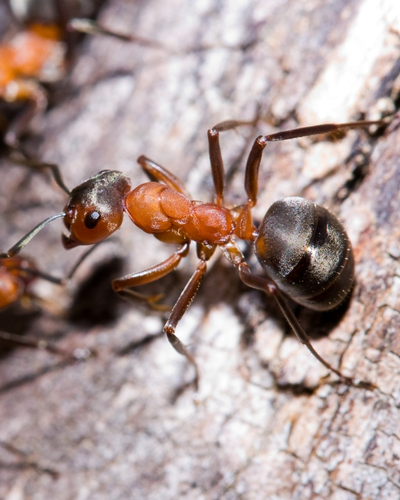
Carpenter ants are the biggest and most damaging ant here. They are about 3/8 to 5/8 inch long and usually black or black with some red. They make nests in damp, soft, or rotting wood. They also get into wall voids and insulation. Carpenter ants do not eat wood. They chew through it to make tunnels, called galleries, for their colony. Wooded yards, wood siding, and damp spots in the Black Hills make carpenter ants very common here.
Pavement ants are small, about 1/8 inch, and brown to black. They nest under driveways, sidewalks, slabs, and foundations. They often come into kitchens and basement rooms looking for food.
Odorous house ants, also called sugar ants, are also about 1/8 inch and dark brown to black. They make strong trails from nests outside into kitchens. They look for sweet or greasy foods. If you crush one, it might smell like rotten coconut.
Field ants are medium-sized, about 1/4 inch, and usually black or red-black. They build mounds in soil and lawns. They mostly stay outside but might come inside during certain seasons.
Flying ants, also called swarmers, are winged ants that can reproduce. Seeing them inside usually means a grown colony is close by. Flying ants can be carpenter ant swarmers or from other species, so identifying them before treatment is key.
Size, nest location, and trail behavior are the fastest clues. This table shows the main details.
| Species | Size | Appearance | Habitat / Nesting | Threat Level | Prevalence in Black Hills |
|---|---|---|---|---|---|
| Carpenter ants | 3/8–5/8 inch | Black or reddish-black | Moist/softened wood, wall voids, framing, siding | High — structural risk | Very high |
| Pavement ants | ~1/8 inch | Brown to black | Under slabs, driveways, foundations | Low to moderate | Common |
| Sugar ants / odorous house ants | ~1/8 inch | Dark brown to black | Kitchens, wall voids, food trails | Low but persistent | Common |
| Field ants | ~1/4 inch | Black or red-black | Outdoor soil mounds, lawns | Low indoors | Seasonal |
Carpenter ants pose the biggest risk to your home’s structure in the Black Hills. Pavement ants are mostly a nuisance and sanitation issue. Sugar ants create trails to food. Never assume flying ants are termites without a proper check.
For help protecting your home, see our residential pest control services. If pests are also a problem outside or in shared spaces, our spider control page covers another common Black Hills pest.
Getting rid of ants in your house starts with knowing you have an infestation. One ant might not be a problem. Repeated trails and activity usually are.
Look for these warning signs:
Winged ants inside often mean a mature colony is nearby. Frass and rustling sounds should be treated as urgent warnings, especially in Rapid City homes with wood siding, wooded lots, or damp foundations.
Carpenter ants are a top wood-destroying insect in northern states like South Dakota. Moisture lets them nest in soft wood and cause hidden damage to framing and siding if not treated. According to SDSU Extension, when frass, rustling, or winged ants show up inside, inspection should be urgent.
A professional inspection can tell you if the problem is kitchen foragers, outdoor nesting ants, or structural carpenter ants. Getting rid of ants in the kitchen for good means finding where they come from, not just cleaning the trail.
Ants are more than a nuisance. Depending on the type, they can damage your property or create food safety problems in your home or business.
Carpenter ant control is most important for structural reasons. Carpenter ants chew galleries, or tunnels, in damp or damaged wood to build nests. Over time, this can weaken framing, sill plates, siding, and window trim. The damage is often hidden inside walls or under siding, so it can get worse before you see it.
Ants can also contaminate food prep surfaces, pantry items, and commercial food service areas. In kitchens, they can become a recurring hygiene issue quickly.
Winged ants are often mistaken for termites. This mistake can delay treatment and let the real problem grow. Here is a simple way to tell them apart: carpenter ants have a narrow pinched waist and elbowed antennae. Termites have a thick, straight body and straight antennae.
Carpenter ants do not eat wood like termites do, but untreated colonies can still cause costly structural damage. This is especially true in damp wood around homes and businesses in South Dakota, where moisture near foundations and siding is common in the Black Hills.
Businesses face added concerns. Sanitation, customer visibility, and operational issues make ant infestations a bigger problem for businesses than homeowners may realize. Our commercial pest control services are made for those situations. If ants are sharing space with other pests in your kitchen or break room, our cockroach control page is also worth a look.
Spring snowmelt, summer warmth, and wooded terrain create perfect ant conditions in Rapid City. These are not just general factors. They directly shape when and where ant problems show up in this part of South Dakota.
When snow melts in spring, moisture increases around foundations, siding, and wood structures. This triggers ant foraging. Rapid spring thaws can push ants indoors as they look for food and stable temperatures.
Peak activity runs from June through September. During these months, colonies are large, active, and looking for food. Fall activity can also rise as colonies prepare for winter.
The Black Hills region has wooded terrain, pine forests, and many properties with wood siding or tree-lined lots. These conditions are perfect for carpenter ants. Homes near mulch beds, firewood stacks, tree roots, siding gaps, or foundation cracks are especially at risk.
Elevation, shade, and moisture retention in the Black Hills can help ant habitat last longer into the season. At around 3,200 feet, Rapid City sees temperature swings that push ants to move more aggressively in warmer months.
In Rapid City and across the Black Hills, ant activity often increases after snowmelt and stays high through summer. Warming temperatures, moisture, and wooded terrain create ideal foraging and nesting conditions. Carpenter ants have become more common in South Dakota, especially around the Black Hills, where they nest in damp wood and threaten structures from spring through fall. Ant problems here are shaped by local climate, not just chance.
Ant activity usually peaks from spring through early fall, especially June through September in South Dakota. Getting rid of ants in the yard means understanding these seasonal patterns and taking action before the colony gets large.
Professional ant control starts with inspection and species identification. Then it moves to targeted colony-level treatment and follow-up monitoring. JanTech Pest Control uses state-certified Commercial Applicators and EPA-registered products to treat ant problems in Rapid City and across the Black Hills.
Here is how the process works:
Baiting systems are important because killing worker ants alone does not stop the colony. The queen keeps making more workers. Bait gets carried back to the source, which makes colony-level control possible.
Exterior barrier treatments can also reduce the number of new ants coming in from outside. This is especially useful on Rapid City homes near wooded lots or mulch-heavy landscaping.
The EPA emphasizes using pesticides according to label directions and favoring targeted treatments like baits. Targeted methods reduce risks and improve colony control compared to random spraying.
JanTech serves homes and businesses in Rapid City, the Black Hills, and nearby South Dakota communities. As a local ant exterminator near you, we tailor every treatment to the specific species and conditions found on-site.
Call JanTech Pest Control at 605-391-9998 for a free ant inspection. We serve homes and businesses throughout the Black Hills area.
The best way to stop ants in South Dakota homes is to remove food, moisture, and entry points. Ants are drawn to kitchens, damp wood, and sheltered nesting areas near foundations and siding. Sealing access and removing what attracts them makes your home or business far less appealing.
These steps help with sugar ants in the kitchen, black ants along the foundation, flying ants near wooded areas, and ants in the yard:
Prevention steps reduce what attracts ants and how easily they get in. They do not always stop an established colony. If ants keep coming back, a professional inspection is the next step.
Kitchen
Yard
Home Exterior
These steps are especially important in Rapid City and the Black Hills, where spring moisture and wooded surroundings create ongoing ant pressure from spring through fall.
If ants keep returning after DIY sprays, the colony is still active. Store sprays kill the workers you see, but they rarely reach the nest. The colony just sends more workers out.
Call a professional ant exterminator near you when:
Carpenter ant signs need fast attention. Hidden wood damage can get worse quickly. The longer a colony goes untreated, the more costly it becomes to fix.
Store products can add up fast when you use them over and over without solving the source. A professional ant exterminator targets the nest and queen, which is more cost-effective than repeated DIY treatments.
Businesses in Rapid City and the Black Hills should call sooner rather than later. Sanitation concerns and customer-facing issues raise the stakes for businesses compared to homes.
Contact JanTech at 605-391-9998 for a free ant inspection in Rapid City and the Black Hills area. Our team serves both residential and commercial customers across South Dakota.
The cost depends on the ant species, how large the infestation is, and what kind of treatment is needed. Carpenter ant cases that need wall void or wood treatment tend to cost more than kitchen sugar ant treatments. A professional inspection is usually needed to give an accurate quote. JanTech provides transparent pricing after the inspection.
Some treatments start reducing activity within a day or two. Full colony elimination often takes one to two weeks. Carpenter ant cases and hidden nest situations can take longer because the colony must contact or ingest the treatment before it affects the queen and brood. Patience after treatment is normal.
JanTech uses EPA-registered products applied according to label directions by state-certified Commercial Applicators. When used correctly, these products are designed for responsible pest control in homes with families and pets. Professional application also helps reduce unnecessary exposure compared to repeated DIY spraying.
Ant activity usually rises in spring and stays active through early fall. Peak pressure in South Dakota runs from June through September. Snowmelt adds moisture, which triggers foraging. Warm temperatures keep colonies active through summer. Fall activity can increase again as colonies prepare for winter.
Carpenter ants have a narrow, pinched waist and elbowed antennae. Their front wings are longer than their back wings. Termites have a thick, straight body, straight antennae, and wings that are roughly equal in size. Carpenter ants chew through wood but do not eat it. Termites actually consume the wood. If you are not sure which one you have, call for an inspection before treating.
They do not damage wood the same way, but carpenter ants can still cause serious structural problems. They hollow out galleries in damp or softened wood, which weakens framing, siding, and trim over time. Untreated colonies in Black Hills homes can do significant damage before anyone notices. If you see frass, hear rustling in walls, or spot winged ants inside, get an inspection right away.
Ant control and extermination services in Rapid City work best when they target the whole colony, not just the ants you can see. Carpenter ants are the biggest structural concern in the Black Hills, but pavement ants, sugar ants, and field ants each bring their own problems that need a different plan.
Baiting and targeted treatment are more effective than random spraying. Finding the nest, treating the colony, and following up with prevention steps are what separate a short-term fix from a long-term solution. Getting rid of ants permanently means stopping the colony at the source.
JanTech Pest Control offers ant pest control services for homes and businesses across Rapid City, the Black Hills, and surrounding South Dakota communities. Our state-certified Commercial Applicators use EPA-registered products and tailored treatment plans to handle each species correctly.
Call JanTech Pest Control at 605-391-9998 for ant control in Rapid City, the Black Hills, and surrounding South Dakota communities. Residential and commercial customers can reach us to schedule a free inspection and get started on a treatment plan that fits their property.